
Cutting Chartership application review from hours to minutes
An engineering professional institution asked Build Your AI for an internal, advisory tool that drafts feedback on Chartership applications. A review that took 2 to 4 hours now takes between 15 minutes and 1 hour.
- Client
- Engineering professional institution
- Sector
- Professional registration
- Engagement
- Internal AI review tool, in production
- Ladder phase
- Build & Validate
The numbers
- Per application review, down from 2 to 4 hours
- 15 to 60 min
- Review tools in production use
- 2
- Competence standard every review is checked against
- UK-SPEC
High volumes of applications, each needing individual feedback
The institution's membership staff support candidates through the pathways to Chartership, including applicants with and without formal degrees. Every application needed detailed, individual feedback before submission.
Each review was manual and took 2 to 4 hours. Staff read the candidate's statements, cross-referenced them against the Engineering Council UK-SPEC competences and wrote the feedback by hand. The depth of feedback varied between reviewers, and the reviews took up a large share of the team's time.
An advisory review tool on private infrastructure
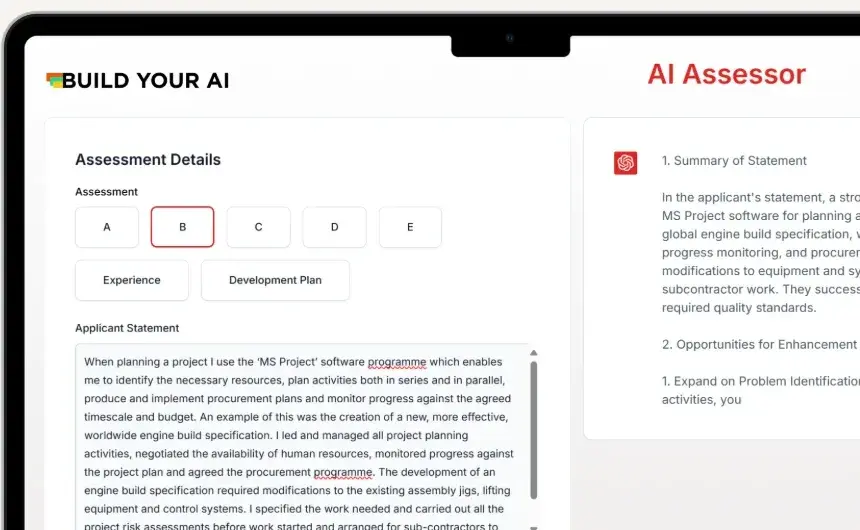
Build Your AI designed and built an internal tool that parses candidate applications and evaluates them against the UK-SPEC competences. Staff receive a structured, criteria-based feedback draft that they review, adjust and send. The tool is advisory, and a member of staff makes every decision.
The tool supports 2 routes. The first is the Chartered Engineer application. The second is the Career Learning Assessment, which candidates use when they did not follow the usual university route and rely on their career experience to show their professional competence.
The tool runs on privately hosted infrastructure, so candidate data stays inside the institution's own environment.
We built the tool around the way the team works:
- Staff upload the application file, and the tool extracts the candidate's answers for them
- Staff see the draft feedback for each competence or application section immediately
- Reviewers rate the feedback and add their own input, and the team uses that input to improve the prompts
- A prompt management system lets the team adjust assessment criteria and feedback style without a developer
- The tool stores every review with a full audit trail, so the institution has a record of each draft and the reasoning behind it
Live in production
Review time fell from 2 to 4 hours to between 15 minutes and 1 hour per application. The membership team uses 2 tools regularly, one for Chartership application review and one for career learning assessments.
Staff now review and adjust a structured draft for each application. The team reports that the tools have reduced the time burden of reviews, and staff spend the recovered time supporting candidates directly.
Where this pattern applies
The tool reviews documents against defined criteria, and it runs in production inside a regulated professional body. The same pattern applies to drawing reviews, requirement checks and validation of supplier outputs. In each case a competent person signs off, and the tool gives that person a consistent first pass with the reasoning recorded.
This work is the Build & Validate phase of the Safe AI Adoption Ladder, the 4-phase method Build Your AI uses to take an engineering organisation from first interest to AI in production. See how the 4 phases fit together.
Want to know where AI would pay back in your engineering team?
Book a free consultation. We will talk through your workflows and your constraints, and suggest a low-risk first step.
Book a consultationMore case studies
- Safety-critical manufacturingFrom AI interest to a procurement-ready AI roadmap
- Noise and vibration consultancyProducing an AI roadmap for a specialist acoustic engineering consultancy
- Medical educationAVA: an AI mock interview platform for 5,000+ medical applicants
- Professional educationAn AI-powered learning platform for teachers, built from scratch