
From AI interest to a procurement-ready AI roadmap
A leading global rail components manufacturer had Copilot licences that few people used and no clear understanding of where AI might be useful. A 2-week discovery produced 58 scored use cases, 6 working prototypes and a costed roadmap, and the office of the CEO then funded the AI programme.
- Client
- Global rail components manufacturer
- Sector
- Safety-critical manufacturing
- Engagement
- AI and automation discovery, prototyping and roadmap
- Ladder phase
- Assess & Identify
The numbers
- Use cases scored and logged
- 58
- AI programme funded by the office of the CEO
- Funded
- Working prototypes on their own data
- 6
- Commercial opportunity identified (client estimate)
- £6M
- Discovery sessions on site
- 33
- Highest-value use cases prioritised
- 13
- Lab team hours targeted by automation
- 100s
- On site with production, engineering and lab teams
- 2 weeks
AI on the agenda without a defensible way to use it
When the client came to Build Your AI, AI was under discussion at every level. Leadership was asking questions, managers were expected to have a view, and engineers were already experimenting on their own.
The organisation had bought Microsoft Copilot licences and few people used them. Ideas for where AI might help existed as informal conversations. The engineering and commercial teams had not scored those ideas, costed them or connected them to the problems their teams faced each day.
Leadership needed 3 things before it could act. It needed a way to identify innovation priorities, a way to quantify ROI and a business case it could defend. Governance and guardrails also had to be agreed before the organisation moved from interest to implementation.
Why informal adoption carried risk
Budget and appetite were both available. The organisation lacked a route from interest to a deployment it could defend, and 3 conditions made informal use of AI risky in this environment.
| Condition | Why it mattered |
|---|---|
| Traceability | Rail component manufacturing runs under quality standards that require an audit trail for decisions affecting product integrity. An AI output has to be traced to its source data and validated against defined criteria before an engineer can rely on it. |
| Data boundaries | The business holds commercially sensitive design data, supplier terms and process parameters. Each informal use of a commercial AI product was an uncontrolled disclosure risk until the organisation had a data handling policy. |
| Ranking | Many people had suggestions. The organisation had not scored them, set the weak ones aside or sequenced the rest, and a procurement review asks for the reasoning behind each choice. |
A 2-week discovery on site
The engagement began with short workshops for engineers and commercial staff. The workshops gave the teams a shared understanding of AI, agreed guardrails for its use and a first list of 15 use case ideas. The idle Copilot licences also moved into routine use.
We then spent 2 weeks on site and ran 33 structured discovery sessions with the production, engineering and lab teams.
- We logged 58 AI and automation use cases in a discovery register.
- We scored each use case on governance readiness, ROI confidence, adoption readiness and operational impact.
- We prioritised the 13 highest-value use cases and parked the other 45, each with a documented reason. The usual reasons were fragmented data, a missing standard process or an integration cost that the return could not yet justify.
- We built 6 working prototypes with the engineers during discovery. Each prototype ran locally on the client's own data, so no data left the site.
- We sequenced the 13 use cases into a phased roadmap and scoped the build phase as a procurement-ready quote.
The prototypes covered documentation assistants, data visualisation and analysis tools, and spreadsheet automation. Together they target hundreds of hours of manual work each year.
What the discovery sessions found
The 33 sessions produced 4 themes with the highest scores.
| Theme | What the sessions showed |
|---|---|
| Lab planning and scheduling | The highest composite score of all 58 use cases. Demand was strong, the build effort was moderate and a working prototype proved the idea within days. |
| Test data processing | Engineers structured and charted test data by hand for each new test. A local web tool now does the same analysis from a single upload. |
| Drafting and checking agents | Engineers in more than 10 separate sessions asked for help drafting reports and reviewing drawings and documents, which showed that the demand was shared across departments. |
| Commercial use cases | Cross-sell recommendations, technical enquiry handling and tender research each had a named champion and a direct link to revenue. |
A procurement-ready AI programme
| Deliverable | What it contains |
|---|---|
| Use case register | All 58 use cases with their scores, the 13 that were prioritised and the reason each of the other 45 was parked. |
| 6 working prototypes | Tools built on the client’s own data that ran from the first day. They include web tools that analyse and visualise sensor data, and tools that automate change notes and the management of lab jobs, equipment and skills. |
| Sequenced AI roadmap | The 13 prioritised use cases set out across delivery phases in a costed plan. |
| PRDs and system diagrams | Product requirement documents for the top-priority use cases, with defined inputs, outputs and success criteria that a build team can work from. |
| Automations and AI discovery report | A visual report of the main findings, the top problems, the prioritised use cases and before and after views of each prototype. |
| Procurement-ready build scope | A scope for the build phase with a defined cost, timeline and assumptions. |
Results
The client took the discovery outputs to its leadership, and the office of the CEO funded the AI programme. The scored register, the working prototypes and the costed scope were the evidence for that decision.
The client also estimated a £6M commercial opportunity linked to the prioritised use cases. The table sets out what changed across the engagement.
| Measure | Before | After |
|---|---|---|
| Shared AI framework | None | Agreed guardrails and best practices for AI across all teams |
| Problems and observations | Informal | Captured in a register and mapped to use cases |
| Use cases | Informal ideas | 58 logged and scored, 13 prioritised |
| Copilot use | Licences unused | Routine use across engineering and commercial teams |
| Working prototypes | None | 6 built on the client’s own data, each saving hours of manual work |
| Engineer time | Hours each week on documentation and data tasks | Up to 1 day a week recovered through personal AI agents (estimate) |
| AI roadmap | None | Sequenced, phased delivery plan with a full use case register |
| Commercial opportunity | Unknown | £6M in client-estimated commercial opportunity linked to prioritised use cases |
| Lab team time | Manual admin, documentation, results analysis and data logging | Hundreds of hours targeted by automation |
| AI programme funding | None | Funded by the office of the CEO |
The sensor data and lab planning prototypes, before and after
We built both prototypes with the engineers during discovery, and both run locally on the client’s own data. Each one is shown beside the process it replaced.
Sensor data analysis
before
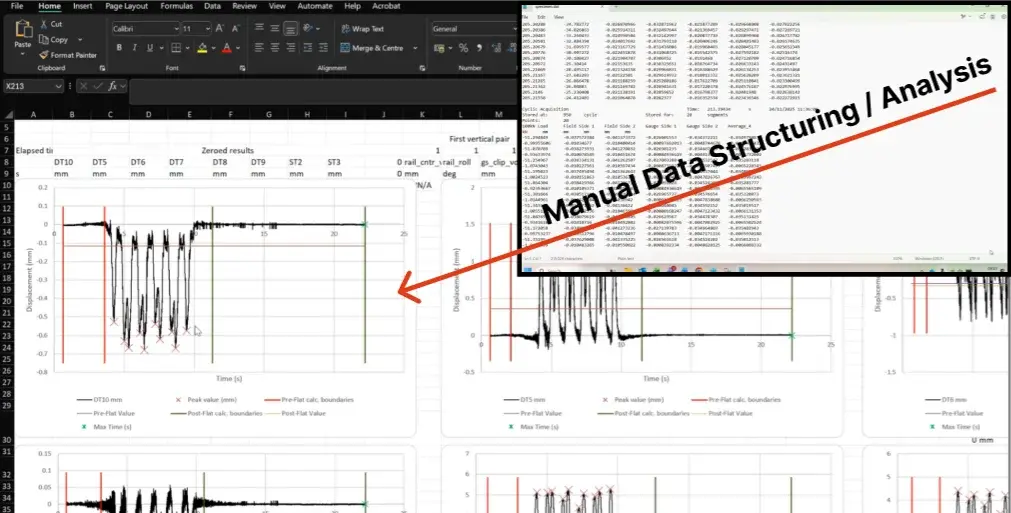
Engineers extracted, structured and charted test data by hand, and had no visual of the track itself. They repeated the work for every new test.
after
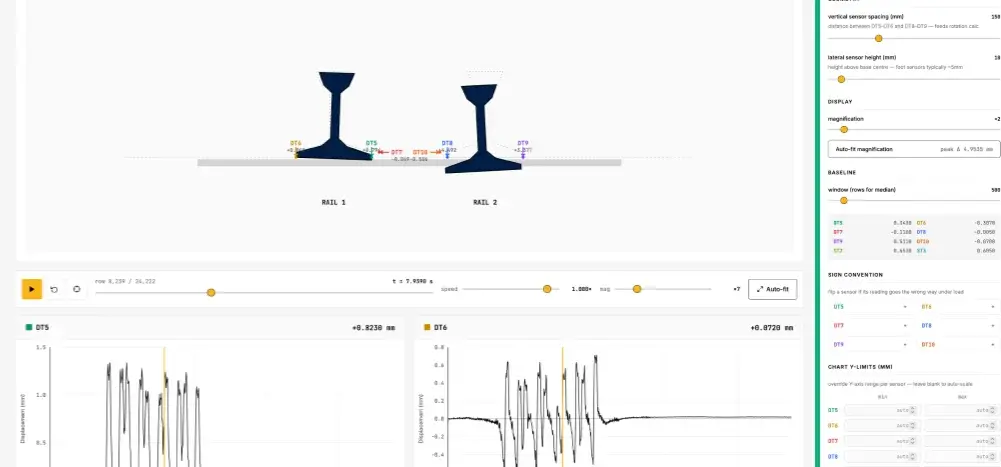
Engineers drag and drop the raw data into a local web tool. The tool draws the track displacement and lets them adjust the settings. A new dataset takes 1 upload.
Lab job planning and scheduling
before
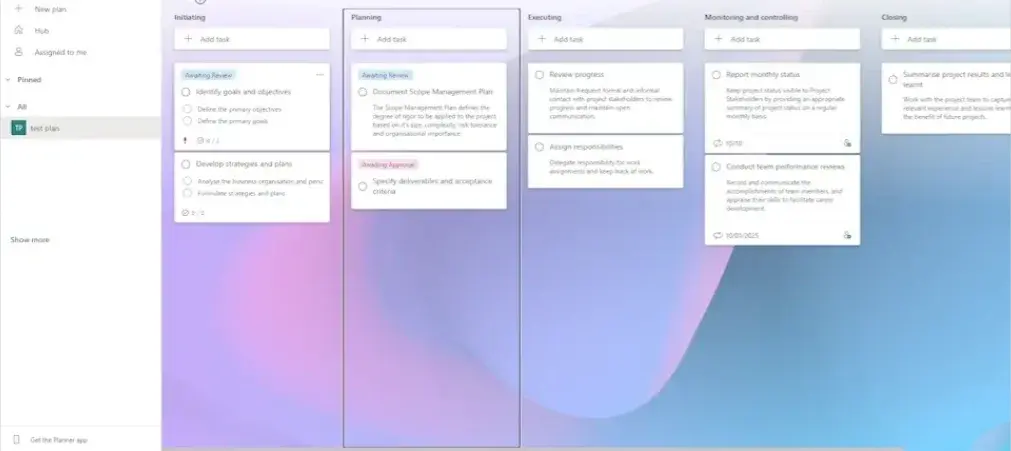
The lab team created each job and task as a card in a personnel bucket in Microsoft Planner. Assigning jobs by hand took hours, and Planner showed no comparison of estimated and actual timelines.
after
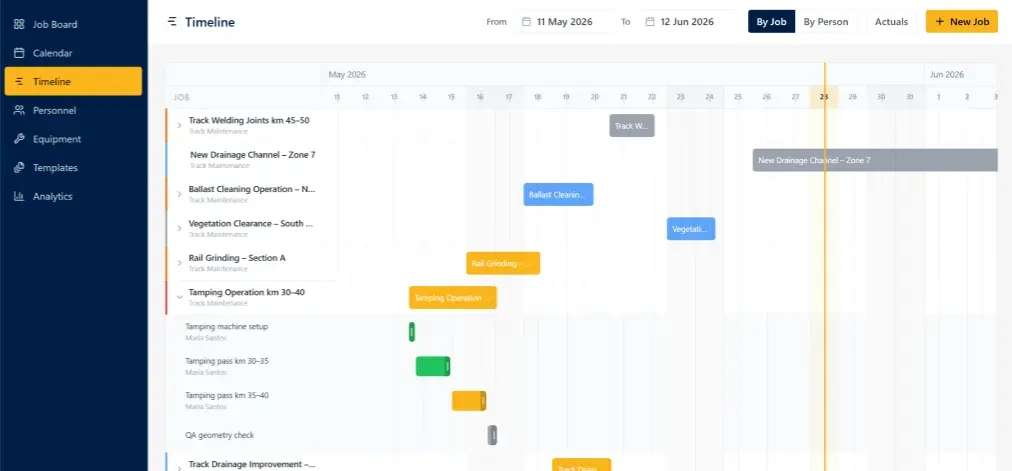
A bespoke tool plans and schedules lab jobs. It has separate views for the job board, calendar, timeline, personnel, equipment, job templates and analytics.
Why the order of work mattered
The result came from the order of the work.
- Build shared understanding.
- Collect and score real use cases from the people who do the work.
- Build only what the evidence supports.
Engineers proposed the use cases, so each one was tied to an operational problem and the team owned it from the start. That ownership lowered the risk of paying for a tool that engineers would leave unused. The prototypes built during discovery also reduced delivery risk before anyone wrote production code.
The 45 parked use cases matter as much as the 13 that were prioritised. The register records why the team set each one aside, so leadership can focus its investment on the tools that engineers will adopt and that can move past a pilot.
This work is the Assess & Identify phase of the Safe AI Adoption Ladder, the 4-phase method Build Your AI uses to take an engineering organisation from first interest to AI in production. See how the 4 phases fit together.
Want to know where AI would pay back in your engineering team?
Book a free consultation. We will talk through your workflows and your constraints, and suggest a low-risk first step.
Book a consultationMore case studies
- Professional registrationCutting Chartership application review from hours to minutes
- Noise and vibration consultancyProducing an AI roadmap for a specialist acoustic engineering consultancy
- Medical educationAVA: an AI mock interview platform for 5,000+ medical applicants
- Professional educationAn AI-powered learning platform for teachers, built from scratch